Is there a fixed number of driving lessons to pass? If you are a beginner getting behind the wheel for the first time, you probably want a clear, exact number so you can budget your time and money. While it is completely normal to ask exactly how many driving lessons to pass UK tests, the reality is that the number depends on multiple factors. Everyone learns at a different pace.
This guide breaks down the data, expert instructor insights, and realistic timelines to help you understand exactly what to expect on your journey to getting a full driving licence.
The UK Driving Lessons Average: What the Data Shows
When planning your budget and schedule, it helps to look at the UK driving lessons average. The Driver and Vehicle Standards Agency (DVSA) recommends that learners take around 45 hours of professional driving lessons, alongside 20 to 22 hours of private practice with family or friends.
Remember, this is an average, not a legal requirement. Some learners take fewer hours, while nervous drivers might need 60 hours or more. The goal is to become a safe, independent driver, not just to rush to the finish line.
Factors Affecting How Many Driving Lessons to Pass UK Tests
Your path to passing the driving test will look different from your friends’ paths. Several variables determine how much time you need to spend in the learner’s seat.
Previous Driving Experience
If you grew up driving tractors on a farm or have ridden a geared motorcycle, you already understand basic vehicle mechanics. Complete beginners will naturally need more hours to master the basics of clutch control and steering.
Learning Speed
Some people naturally pick up physical coordination quickly, while others take time to build muscle memory. Nervous learners often need extra lessons simply to build their confidence on busy roads, which is a normal and expected part of the process.
Lesson Frequency
Taking a one-hour lesson every two weeks makes it hard to retain information. Consistency is vital. Taking two-hour lessons weekly or booking an intensive driving course usually helps learners progress much faster.
Location and Road Conditions
Learning to drive in a quiet rural village requires a different skill set than navigating complex multi-lane roundabouts in a bustling city like London or Birmingham. City driving often takes slightly more time to master due to complex traffic systems.
Manual vs. Automatic
Learning in a manual car takes longer because you have to master the clutch and gear changes. Automatic cars simplify the process, meaning learners often require fewer driving lesson hours UK wide. However, remember that an automatic licence restricts you to driving only automatic cars.
Your Driving Lesson Timeline: From Beginner to Test Ready
Most professional driving instructors follow a structured progression plan. Here is what a typical learning journey looks like:
- Stage 1: Basic Controls. Learning the pedals, steering, moving off, and stopping safely.
- Stage 2: Road Awareness. Dealing with junctions, roundabouts, traffic lights, and pedestrian crossings.
- Stage 3: Complex Roads and Traffic. Navigating dual carriageways, rural roads, and heavy city traffic.
- Stage 4: Mock Tests and Readiness. Perfecting your manoeuvres, following a sat-nav independently, and taking practice tests to simulate exam conditions.
How to Know You Are Ready for DVSA Driving Test Preparation
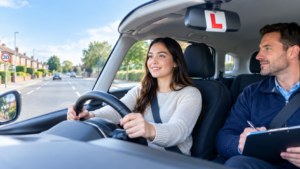
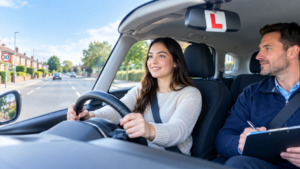
Booking your test too early is a common mistake. You are truly ready for your DVSA driving test preparation when you can drive for your entire lesson without your instructor needing to use their dual controls or give you verbal prompts.
You should feel confident performing all reversing manoeuvres, show excellent hazard awareness, and consistently pass your mock tests with very few minor faults and zero serious faults.
Why Some Learners Require Fewer Driving Lesson Hours UK
From an instructor’s perspective, the learners who pass faster usually share a few common traits. They have a natural confidence behind the wheel and supplement their professional lessons with high-quality private practice.
They also benefit from highly focused learning. Instead of driving around aimlessly, they set clear goals with their instructor for every single lesson. Finding an approved driving instructor (ADI) who matches your learning style is crucial to keeping your lesson count down.
Common Mistakes That Increase Your Driving Lesson Count
Certain habits will easily add 10 or 20 hours to your learning time. Avoid these common pitfalls:
- Long gaps between lessons: You will spend the first 20 minutes of your lesson relearning what you forgot.
- Ignoring theory: If you do not understand road signs or right-of-way rules, your practical progress will stall.
- Ignoring feedback: Failing to correct bad habits early makes them harder to fix later.
- Rushing to book the test: Failing a test knocks your confidence and usually requires a long wait (and more lessons) before you can try again.
Expert Advice on How Many Driving Lessons to Pass UK Exams
Driving instructors consistently stress that there is no magic number. Focusing too heavily on hitting a specific hour count creates unnecessary anxiety.
Experts recommend taking regular, two-hour lessons each week to build strong muscle memory. They also advise strongly against booking your practical test before you have passed a mock test. Trying to cut corners usually leads to failed tests, which costs you much more time and money in the long run.
The Learner Driver UK Cost: How Lessons Impact Your Wallet
Let’s look at the financial reality. The average cost of a driving lesson in the UK currently sits between £35 and £50 per hour, depending on your location.
If you require the DVSA average of 45 hours, your total learner driver UK cost for lessons alone will range from £1,500 to £2,250. Factor in the cost of your provisional licence, theory test, practical test, and learner insurance, and you can easily exceed £2,500. Rushing your training and failing tests will only push this number higher.
Tips to Reduce the Number of Lessons You Need
You can actively keep your costs down and pass faster by taking a strategic approach to your learning:
- Practice with a supervising driver: If possible, spend time in a family member’s car practising the skills your instructor taught you.
- Study your theory early: Pass your theory test as soon as possible so you understand the rules of the road.
- Book regular lessons: Avoid taking weeks off. Keep your momentum going.
- Focus on weak areas: Do not just drive around comfortably. Ask your instructor to repeatedly practice the junctions or manoeuvres that scare you the most.
Frequently Asked Questions
How many driving lessons do most people need UK?
Most people need around 45 hours of professional lessons and 20 hours of private practice to reach test standard.
Can I pass with 20 lessons?
While highly uncommon for a complete beginner in a manual car, someone with significant prior experience or someone learning in an automatic might achieve this. For most, 20 hours is not enough.
Is 40 hours enough to pass driving test UK?
Yes, 40 hours is very close to the national average. If you take regular lessons and practice privately, 40 hours is often a realistic target.
What is the fastest way to learn driving?
The fastest route is to take an intensive driving course alongside passing your theory test early, while learning in an automatic vehicle.
Final Thoughts on Passing Your Driving Test
Getting your driver’s licence is an investment in your independence and safety. While everyone wants to know exactly how many driving lessons to pass UK tests, the best approach is to focus on your personal progress rather than a ticking clock.
Expect to budget for around 45 hours of professional instruction. By combining structured professional lessons with consistent private practice, studying your theory early, and taking your instructor’s advice, you will be well on your way to tearing up your L-plates.