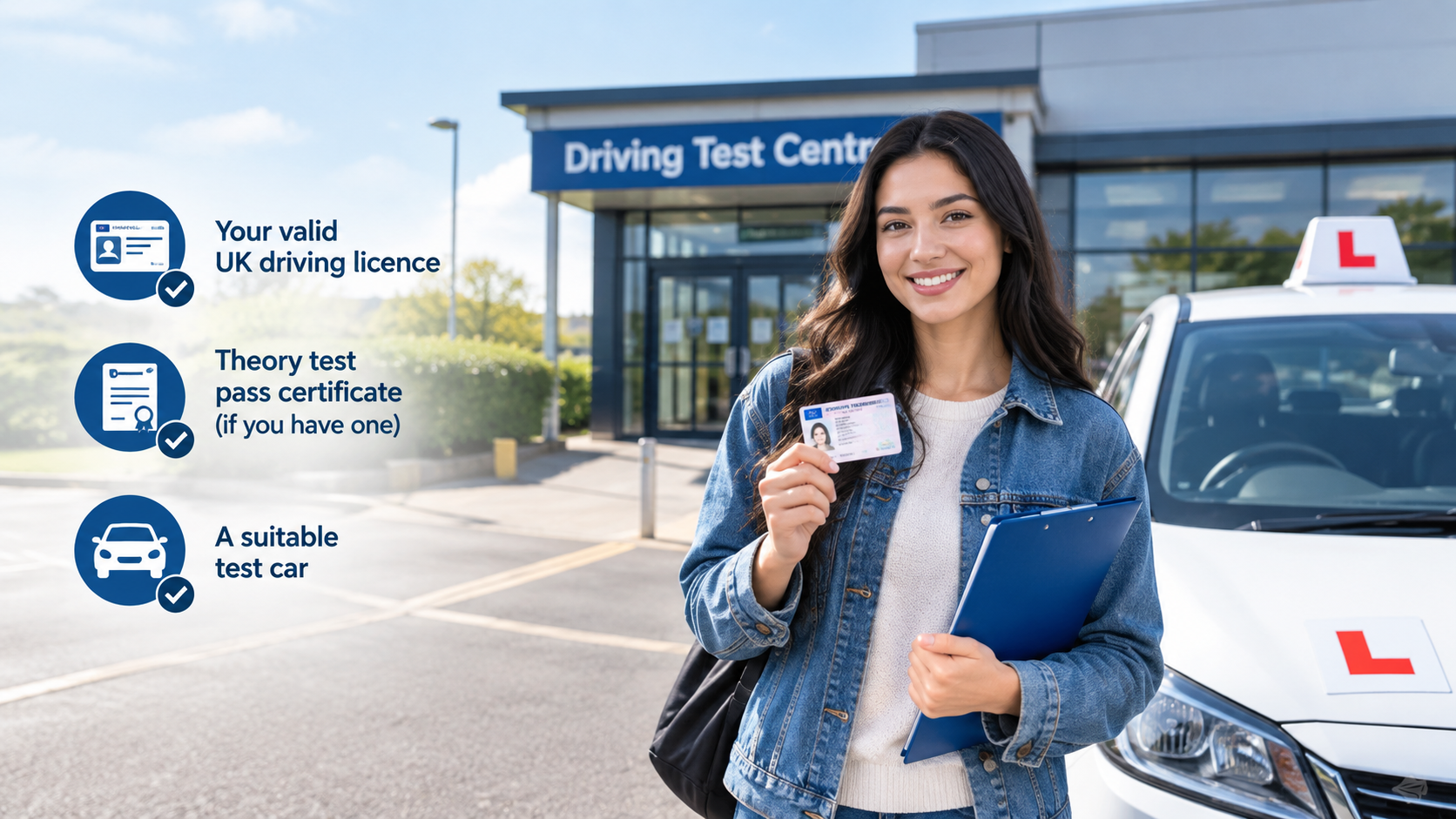
Your practical driving test day starts long before you turn the key. What you bring, and what state your car is in, can decide whether the test goes ahead at all. Turn up without the right documents or an unsuitable vehicle, and the examiner can cancel your test on the spot — and you may lose your fee.
The good news: the essentials are simple, and the list is short. This guide walks you through exactly what to take, what to check on the car, and what to sort the night before, so nothing catches you out.
What do you need to take on your driving test?
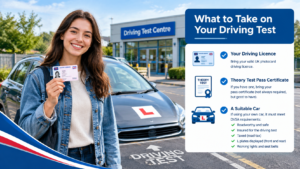
You need to take two official items: your UK driving licence and a suitable, roadworthy car. Those are the requirements set by the Driver and Vehicle Standards Agency (DVSA) for the car practical test.
Here’s the short version:
- Officially required: Your valid UK driving licence and a car that meets the test requirements.
- Useful to bring: Your test booking confirmation, glasses or contact lenses (if you need them to drive), your instructor, and a bit of water.
- Not usually needed: Your theory test pass certificate. You don’t have to bring it to the practical test.
Everything else below explains these points in detail. Rules can change, so check the latest guidance on GOV.UK before your test day.
Do I need to bring my driving licence?
Yes. Your UK driving licence is the one document you must bring. Without it, the examiner will not conduct the test.
For most people, this means your photocard driving licence. Bring the plastic photocard — it proves your identity and confirms you hold a valid provisional entitlement.
A few situations need extra care:
- Old-style paper licence. If you have a paper licence issued before the photocard existed, you’ll usually need to bring a valid passport as proof of identity alongside it. Check the current rule on GOV.UK, as accepted forms of ID can change.
- Northern Ireland licence. If you hold a Northern Ireland provisional licence, bring both parts if you were issued a photocard and paper counterpart. Confirm the requirement before you travel.
- Lost or damaged licence. If your licence is missing or damaged, apply for a replacement in good time. You cannot sit the test without valid identification.
Preparing for lessons and your test with a qualified professional makes this stage simpler — a good instructor at Flex Driving Academy will remind you what to bring and help you feel ready. Learning with someone who knows the local test routes removes a lot of the guesswork.
Next step: Put your photocard licence somewhere you can’t forget it — bag, jacket, or car — the night before.
Do I need to take my theory test certificate?
No. You do not need to bring your theory test pass certificate to your practical driving test.
The DVSA already has a record of your theory pass linked to your licence. When you book the practical test, the system checks that your theory certificate is valid and hasn’t expired. That’s why you’re allowed to book at all.
That said, keep the following in mind:
- Your theory pass lasts two years. Your practical test must fall within that window.
- If your theory certificate expires before you pass the practical, you’ll have to take the theory test again.
So while the certificate isn’t a required item to carry, its validity matters. Check the expiry date well before test day.
Do I need to bring anything else?
You must bring anything that affects your ability to drive legally and safely — and one item stands out.
Glasses or contact lenses. If you need them to meet the eyesight standard, wear them. The test begins with an eyesight check: you’ll be asked to read a number plate from about 20 metres for a new-style plate, or 20.5 metres for an old-style plate. New-style plates start with two letters followed by two numbers, such as AB51 ABC. Fail the check, and the test ends immediately. Don’t rely on “getting by” without your glasses.
Beyond that, a few items make the day smoother:
- Test booking confirmation — your reference number and appointment time, printed or on your phone.
- Water — useful if nerves leave your mouth dry.
- Your instructor — you’re allowed to have them (or a supervising driver) sit in the back during the test if you wish. An observer must be over 16 and follow the DVSA rules for observing tests, and they cannot take any part in the test itself.
None of these last items are mandatory. They simply help you arrive calm and on time.
What should I wear to my driving test?
Wear comfortable clothing and sensible footwear that lets you feel the pedals clearly. There is no dress code, but your shoes matter more than you’d think.
Good choices:
- Flat, thin-soled shoes such as trainers.
- Footwear that grips the pedals and doesn’t slip.
Avoid:
- Chunky boots or heavy soles that dull your feel for the pedals.
- High heels, flip-flops, or bare feet.
- Anything that limits your movement or vision.
Dress for the weather too. If it’s bright, a pair of sunglasses can help — just remove them if it clouds over, as driving in sunglasses in poor light is unsafe.
Can I use my own car for the driving test?
Yes, you can use your own car — provided it meets the DVSA’s requirements. Many learners use their instructor’s car instead, which is often the easier route.
If you’re using your instructor’s vehicle, confirm the arrangement in advance. Ask directly: will you provide the car, and will it be test-ready on the day? A reliable instructor will handle the L-plates, the extra mirror, insurance, and roadworthiness for you.
If you’re bringing your own car, the responsibility sits with you. That’s where the next section comes in.
What should I check on my car before the test?
Your car must be legal, roadworthy, and set up for the examiner. If it isn’t, the test can be cancelled and you may forfeit your fee. Go through this checklist before you leave home.
Documents and legal status
- Tax — the vehicle must be taxed.
- MOT — if the car is over three years old, it needs a valid MOT.
- Insurance — you must be insured to drive the car for the test. Standard learner insurance may not automatically cover the test itself, so check your policy covers you for the practical exam.
Vehicle setup for the examiner
- L-plates — display L-plates (or D-plates in Wales) on the front and rear. Remove them from the windows so they don’t block visibility.
- Extra interior mirror — the examiner needs an additional rear-view mirror fitted for their use.
- Passenger seatbelt and head restraint — both must be fitted and in working order for the examiner’s seat. Slip-on head restraints are not allowed.
- Passenger seat — must adjust and be safe to sit in.
Car specification
- Speed and speedometer — the car must be able to reach at least 62mph and have an officially fitted mph speedometer. An extra display or a smartphone app doesn’t count.
- Wheels and weight — the car must have four wheels and a maximum authorised mass (MAM) — the loaded weight limit listed in the handbook — of no more than 3,500kg.
- No space-saver spare — the car must not have a space-saver spare tyre fitted.
Roadworthiness
- Tyres — legal tread depth (at least 1.6mm), no damage, correct pressure.
- Warning lights — no dashboard warning lights showing faults, such as the engine or airbag light.
- Lights, indicators, brakes, and horn — all working.
- Windscreen — clear and undamaged, with working wipers and washers.
Space and visibility
- Clear view for the examiner — nothing blocking their sight lines.
- Clean and tidy — remove clutter, rubbish, and loose items from the seats and footwells. The car must also be smoke-free, so you cannot smoke in it just before or during the test.
Recalled vehicles
Some models — including certain Citroën and DS Automobiles cars affected by an airbag recall — can only be used if you have proof they’re safe. The examiner will usually check this online before the test, but you may need to bring the recall letter, headed notepaper from the manufacturer or dealer, or a screenshot from the recall service. Check whether your car is affected on GOV.UK well before your test day.
Next step: Run this check the evening before, then a quick final look on the morning. If anything’s wrong, using your instructor’s car is the safer option.
What happens if I forget my driving licence?
If you forget your licence, your test will almost certainly be cancelled — and you’ll usually lose your fee. Identification is not optional, and examiners cannot make exceptions.
The fix is prevention. Set a reminder, and place your licence with your car keys the night before so the two travel together.
What should I do the night before my driving test?
Prepare everything the night before so the morning is calm. Nervous, rushed starts lead to silly mistakes.
Work through these steps:
- Set out your licence and booking confirmation.
- Check the car against the roadworthiness list, or confirm your instructor’s car is ready.
- Lay out sensible shoes and weather-appropriate clothing.
- Get a proper night’s sleep — tiredness slows your reactions.
- Plan your journey to the test centre , allowing time to arrive early and settle.
A short, relaxed warm-up drive with your instructor beforehand often helps steady the nerves.
Frequently asked questions
Do I need my theory certificate for the practical test?
No. The DVSA checks your theory pass electronically when you book. You don’t need to bring the certificate.
What ID do I need for my driving test?
Your UK photocard driving licence. If you hold an older paper licence, you may also need a valid passport — check GOV.UK for the current rule.
Can I wear trainers for my driving test?
Yes. Flat, thin-soled trainers are ideal. Avoid heavy boots, heels, or anything that dulls your feel for the pedals.
Do I need to bring my instructor?
No, but you can. You’re allowed an instructor or supervising driver to sit in during the test. They must be over 16 and follow the DVSA rules for observing tests.
What if my car fails the pre-test check?
The test may be cancelled and your fee lost. If your own car isn’t test-ready, use your instructor’s vehicle instead.
Ready to pass with confidence?
The right preparation turns test day from stressful to straightforward. If you’d like professional lessons, a mock test, or a test-ready car with a qualified instructor by your side, Flex Driving Academy can help you get there. Get in touch to book your lessons and walk into your practical test fully prepared — visit Flex Driving Academy to get started.
Always confirm the latest requirements on GOV.UK before your test, as official rules can change.