Passing your driving test comes down to one thing: driving safely and confidently on your own, without your instructor prompting you. It isn’t about memorising a route or getting lucky on the day. Examiners want to see that you can handle real roads, real traffic and real decisions calmly and consistently.
That skill is built over weeks of proper practice, not crammed the night before. Most learners who struggle aren’t bad drivers — they simply booked their test before they were genuinely ready. If you’re unsure where you stand, structured driving lessons with an approved instructor will give you an honest picture of your progress and the gaps you still need to close.
This guide walks you through exactly what the practical test assesses, how to prepare, the mistakes that catch learners out and how to steady your nerves on the day.
How Do I Pass My Driving Test?
To pass your UK driving test, build safe, consistent and independent driving skills, understand the Highway Code and practise common test situations across different roads. Take the test only when you can drive confidently without regular instructor prompts and avoid serious or dangerous faults throughout.
What Does the Driving Test Assess?
The UK practical driving test assesses whether you can drive safely and independently in varied conditions. It lasts around 35 minutes, and the examiner watches how you handle everyday situations rather than looking for perfection.
The test currently covers five main areas:
- An eyesight check — reading a number plate from about 20 metres.
- “Show me, tell me” vehicle safety questions — one asked before you drive, one while driving.
- General driving ability — your control, observation and judgement in normal traffic.
- Reversing your vehicle — one manoeuvre chosen by the examiner.
- Independent driving — around 20 minutes following a sat-nav or road signs.
Everything ties back to the Highway Code — the official rules and guidance for UK road users. Examiners want to see you apply those rules naturally: correct speed for the conditions, safe gaps, proper signalling and good awareness of other road users.
Your next step: read the DVSA guidance on GOV.UK so you know precisely what the examiner is marking.
How Do I Know When I’m Ready for My Test?
You’re ready for your test when you can drive independently without your instructor stepping in. If you still rely on regular reminders to check mirrors, signal or judge junctions, you need more practice before booking.
Readiness shows up as consistency. You should be able to drive well across:
- Busy town centres and quiet residential streets
- Roundabouts, crossroads and complex junctions
- Dual carriageways and higher-speed roads
- All the required reversing manoeuvres
- Different weather and light conditions
One good drive isn’t enough — you want the same calm, safe standard every time. The most reliable way to check is a mock test. Ask your instructor to run one under realistic conditions and mark it as an examiner would.
Your next step: book a mock test and treat the result as your honest benchmark for readiness.
What Core Driving Skills Should I Practise?
The core driving skills are the everyday actions the examiner watches from start to finish. Master these and the test itself feels far less daunting.
Moving off and vehicle control
Move off safely every single time. Check your mirrors, look over your right shoulder for the blind spot, signal if needed and pull away smoothly. Use the clutch, gears, brakes and steering with control — jerky, uncertain handling is one of the clearest signs of a nervous, underprepared driver.
Mirrors, observation and signalling
Check your mirrors before every decision — before signalling, changing speed, changing direction or turning. Signal clearly and only when it helps other road users. A signal given too late, or one left flashing after a manoeuvre, both count against you.
Junctions, roundabouts and speed
Approach junctions and roundabouts at a speed that lets you react. Look properly, judge gaps sensibly and proceed when it’s safe — don’t creep out or freeze when the way is clear. Match your speed to the limit and the conditions, staying within limits while keeping up with traffic where it’s safe.
Positioning, overtaking and awareness
Hold a steady, correct road position and stay in the right lane on roundabouts and dual carriageways. Meet oncoming traffic safely on narrow roads, only overtake when it’s genuinely safe, and watch constantly for pedestrians, cyclists and changing road signs.
Manoeuvres, parking and hill starts
Practise every reversing manoeuvre — parallel parking, bay parking and pulling up on the right — until your observations are second nature. Nail your hill starts so you move off without rolling back.
Your next step: list any skill above that still feels shaky and make it the focus of your next lesson.
How Are Driving Faults, Serious Faults and Dangerous Faults Assessed?
Driving test faults fall into three categories, and understanding the difference tells you exactly what to protect against.
- Driving faults (minors) — small mistakes that aren’t potentially dangerous. You can accumulate up to 15 and still pass.
- Serious faults (majors) — mistakes that could become dangerous. One serious fault fails the test.
- Dangerous faults — actions that create actual danger to you, the examiner, the public or property. One dangerous fault fails the test.
Here’s the catch many learners miss: repeated driving faults can escalate. If you make the same minor error again and again — say, poor mirror checks — the examiner may mark it as a serious fault because it shows a habit, not a one-off slip.
Your next step: after every practice drive, ask your instructor which faults you repeated, then target those specific habits.
How Does Independent Driving Work?
Independent driving is the section where you drive without turn-by-turn instructions for around 20 minutes. You’ll either follow directions from a sat-nav (set up by the examiner) or a series of traffic signs.
The point isn’t your navigation — it’s your safe driving. Take a wrong turn and you won’t fail for it, as long as you keep driving safely. The examiner will guide you back on route if needed.
So don’t panic if you miss a turning or misread a sign. Stay calm, keep your observations sharp and carry on as normal.
Your next step: practise following a sat-nav on unfamiliar roads so the format feels routine before test day.
How Should I Prepare for “Show Me, Tell Me” Questions?
The “show me, tell me” questions check that you understand your car’s basic controls and safety features. The examiner asks one “tell me” question before you set off and one “show me” question while you’re driving.
These cover simple, practical checks — how you’d check the brakes, operate the demister, wash the windscreen or check tyre pressures. The full list is published on GOV.UK, so there are no surprises.
The real risk is distraction. When you get the “show me” question on the move, complete it without taking your attention off the road. If operating a control safely isn’t possible at that moment, wait until it is.
Your next step: run through the official question list until you can answer each one from memory.
What Are the Most Common Driving Test Mistakes?
The most common driving test mistakes are small lapses in observation and judgement — not dramatic errors. Knowing them in advance lets you guard against them.
Watch closely for these:
- Poor observations at junctions, before moving off and during manoeuvres
- Late, missing or unnecessary signals
- Driving too fast or too slowly for the conditions
- Poor lane discipline, especially on roundabouts
- Hesitation when it’s clearly safe to proceed
- Unsafe moving off without proper blind-spot checks
- Weak judgement when emerging at junctions
- Losing concentration and drifting late in the test
Most of these are habits, which means practice can fix them. The learners who pass are usually the ones who ironed out these small errors before booking.
Your next step: pick your two most frequent mistakes and rehearse the correct response until it’s automatic.
How Can I Stay Calm During the Test?
Nerves are normal, and you won’t switch them off completely — but you can stop them controlling your driving. Preparation is the strongest calming tool you have, because confidence comes from knowing you can already do the job.
A few practical habits help:
- Stick to your routine — drive exactly as you do in lessons.
- Focus on one decision at a time — the mirror check in front of you, not the whole test.
- Breathe steadily and keep your movements slow and deliberate.
- Accept small slips — one minor fault is not a fail, so don’t dwell on it.
Treat the examiner as a passenger, not a judge. Your job is simply to drive safely, the way you already know how.
Your next step: practise your calming routine during your final mock test so it’s familiar when it matters.
What Should I Do on Test Day?
On test day, keep things simple and give yourself no reason to feel rushed. A short checklist removes the last-minute panic.
- Rest well the night before — tiredness slows your reactions.
- Arrive early so you’re not flustered.
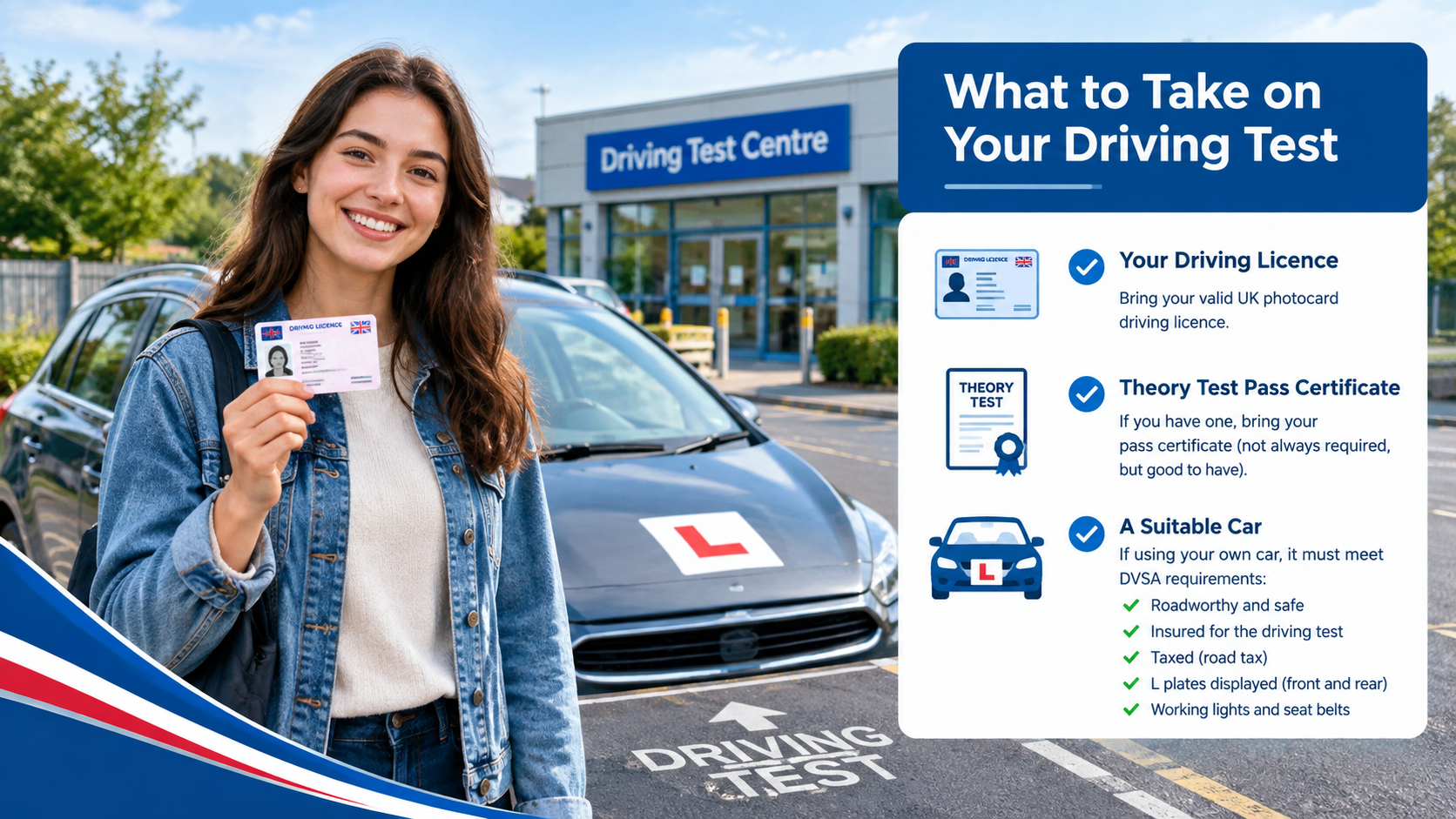
- Bring your provisional licence and any required documents.
- Check the car is clean, legal and roadworthy.
- Adjust your seat, mirrors and head restraint before you set off.
- Listen carefully to the examiner’s instructions — ask if anything is unclear.
- Take your time on every decision; there are no prizes for rushing.
Your next step: pack your documents and prepare the car the evening before, not the morning of.
What If I Don’t Pass?
Not passing isn’t the end — it’s a clear map of what to work on. Your examiner records every fault, and GOV.UK explains each area so you know exactly where you slipped.
Sit down with your instructor, go through the feedback and turn each fault into a practice goal. Then rebook only once you’ve genuinely closed those gaps. Many confident drivers didn’t pass first time, and the second attempt is often far smoother because the pressure of the unknown is gone.
Your next step: review your feedback sheet with your instructor within a few days, while the drive is fresh.
Ready to Take the Next Step?
Passing your driving test is the result of steady, well-guided practice and honest feedback on where you stand. Focus on safe, independent driving, learn from every fault and only book your test when you’re genuinely ready.
If you’d like structured support to get there, Flex Driving Academy offers professional driving tuition tailored to your pace and confidence. Get in touch to arrange lessons, a mock test or an honest chat about your readiness — and take the next step towards driving on your own.