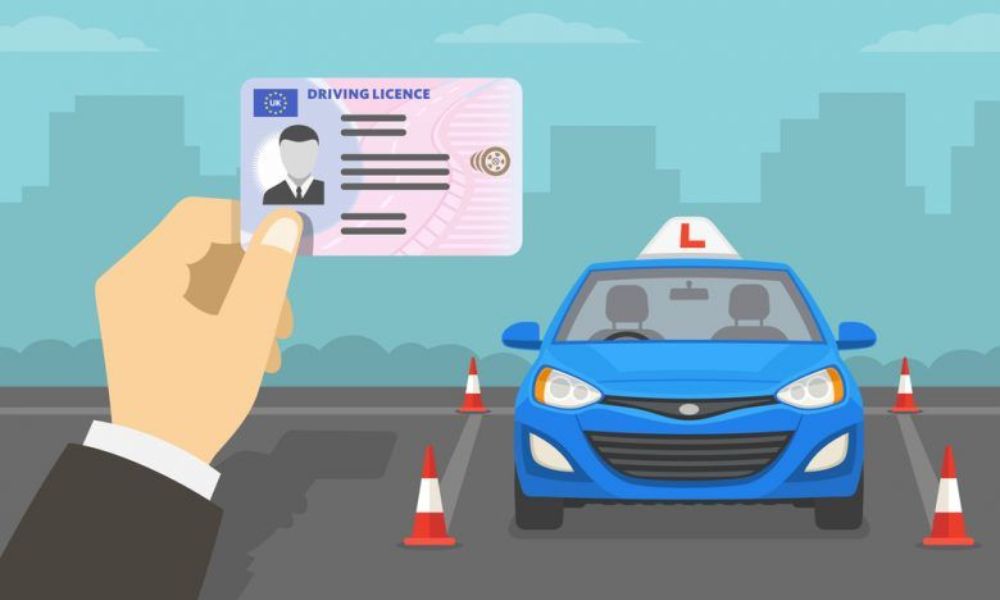
To get a driving licence in the UK, you must apply for a provisional licence (from age 15 years 9 months, valid from 17), pass a theory test (£23), and pass a practical driving test (£62–£75). The full process typically takes several months and around 30–45 hours of professional lessons, though intensive courses can compress the timeline significantly.
Getting a full UK driving licence involves more steps than most first-timers expect. There’s the provisional application, the theory test, the practical test, and everything in between. Each stage has its own rules, fees, and requirements — and getting any of them wrong can delay the whole process.
This guide walks you through every step, with verified fees and requirements sourced directly from GOV.UK and the DVSA. By the end, you’ll know exactly what to do, when to do it, and how much it will cost.
One important note before we start: this guide covers Great Britain only. Northern Ireland operates a separate licensing system with different fees and procedures. If you’re based in Northern Ireland, check nidirect.gov.uk for the correct information.
What Are the Steps to Get a Driving Licence in the UK?
Here’s the full journey at a glance, before we go into each stage in detail.
Step 1: Check If You Are Eligible
Before you apply for anything, confirm you meet the basic requirements set out by the DVLA (Driver and Vehicle Licensing Agency):
- You must be at least 15 years and 9 months old to apply for a provisional licence
- You must be able to read a number plate from 20 metres in good daylight
- You must have permission to live in Great Britain for at least 185 days in the year you apply
Most learners can begin driving on public roads from their 17th birthday. The one exception: if you receive the higher rate mobility component of the Personal Independence Payment (PIP), you may start from age 16.
Step 2: Apply for a Provisional Driving Licence
Your provisional licence is the legal document that lets you learn to drive on public roads. You must hold one before taking lessons with a professional instructor.
How to apply:
- Online via GOV.UK: £34 — the faster, cheaper option
- By post (form D1): £43 — forms are available at most Post Offices
Always apply through GOV.UK. Unofficial websites typically charge more and offer no added benefit.
Common Learner Mistake: Many learners wait until their 17th birthday to apply. Don’t. You can apply from 15 years and 9 months, which means your licence could arrive well before you’re legally old enough to drive — so you’re ready to start lessons the moment you turn 17.
Step 3: Start Learning to Drive
Once your provisional licence arrives, you can begin taking lessons. In Great Britain, learner drivers must display L-plates (red “L” on a white background) on the front and back of the vehicle at all times when driving on public roads.
Most learners work with a DVSA-approved driving instructor, who will be covered by their own vehicle insurance. You only need separate insurance if you practise in your own or a family member’s car.
Instructor Tip: Look for a DVSA-approved instructor — they’ll display a green badge. Check recent reviews, and confirm they’re familiar with the routes around your local test centre. Booking a single assessment lesson before committing to a full course is a sensible way to check whether their teaching style suits you.
Step 4: Prepare for the Theory Test
The UK theory test has two parts, and you must pass both in the same sitting:
- Multiple choice: 50 questions — you need at least 43 out of 50 to pass
- Hazard perception: a video-based test — you need at least 44 out of 75 to pass
You cannot pass one part and sit the other separately. Both must be passed together in a single session.
To prepare effectively, use the official DVSA revision materials. Mock tests, hazard perception practice clips, and the Highway Code are all essential study tools.
Step 5: Pass the Theory Test
The theory test costs £23 (the same rate applies on weekdays and weekends, as confirmed by GOV.UK/DVSA). You must hold a valid provisional licence to book your test.
You can sit the test from your 17th birthday — or from age 16 if you receive PIP at the enhanced mobility rate.
Common Learner Mistake: Booking the theory test too early. Many learners book a slot before they feel genuinely ready, then fail and have to wait, repay, and rebook. Only book when you’re consistently scoring above the pass mark in practice tests.
Your theory test pass certificate is valid for two years. If you don’t pass your practical test within that window, you’ll need to sit the theory test again.
Step 6: Prepare for the Practical Driving Test
The UK practical driving test covers four main areas:
- Eyesight check — reading a number plate from 20 metres
- ‘Show me, tell me’ vehicle safety questions — one question answered while stationary, one while driving
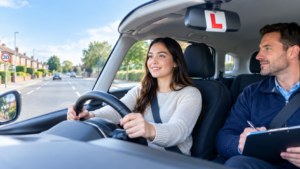
- General driving ability — 20 to 35 minutes of independent driving, following either a sat nav or road signs
- One reversing manoeuvre — this will be one of: a parallel park, a bay park (forward or reverse), or pulling up on the right and reversing
The full test lasts approximately 35 minutes. The DVSA does not publish official test routes, so there’s no shortcut to learning your way around them — consistent practice across a variety of roads and conditions is the only reliable approach.
Instructor Tip: Your instructor will tell you when you’re genuinely ready. Don’t push to book your practical test before they think you’re at the right standard. Booking too early wastes money and can dent your confidence.
Step 7: Take and Pass the Practical Driving Test
Practical driving test fees (sourced from GOV.UK/DVSA):
- £62 on weekdays
- £75 on evenings, weekends, and bank holidays
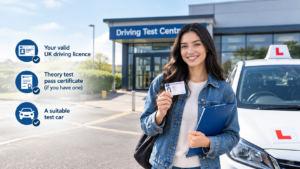
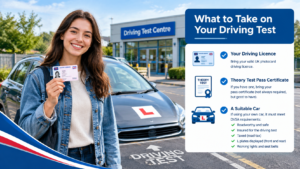
On test day, bring:
- Your provisional driving licence photocard
- Your theory test pass certificate (or confirmation)
Without both documents, your test may not go ahead.
Test-Day Tip: Arrive early, but not so early that you’re sitting with your nerves for 45 minutes. Aim for 10 to 15 minutes before your slot. Do a calm, familiar drive to the test centre with your instructor rather than arriving by public transport under pressure.
Important change as of 12 May 2026: Only the learner — not the instructor or driving school — can book, change, swap, or cancel a practical driving test. Your instructor can advise you on timing and help you choose a sensible test centre, but the booking itself must be made by you through GOV.UK.
Step 8: Receive Your Full Driving Licence
Pass your practical test and you can drive unaccompanied immediately. The examiner will take your provisional photocard licence and give you a pass certificate, which acts as proof of your entitlement while you wait for your full licence to arrive in the post.
The DVLA typically sends the full licence automatically after a pass — you don’t need to apply separately in most cases.
How Old Do You Have to Be to Get a Driving Licence in the UK?
According to GOV.UK and the DVLA:
- You can apply for a provisional licence from age 15 years and 9 months
- You can start driving on public roads from your 17th birthday
- You can start from age 16 if you receive the higher rate mobility component of the Personal Independence Payment (PIP)
The provisional licence itself is valid before your 17th birthday, but you cannot use it to drive on public roads until you reach the qualifying age.
How Do I Apply for a Provisional Driving Licence?
Apply online via GOV.UK for £34, or by post using form D1 (available from most Post Offices) for £43. Online is faster and cheaper.
To apply, you’ll need:
- Your UK passport (or another acceptable form of identity)
- Your National Insurance number
- Your address history for the past three years
The DVLA will check that you meet the residency requirement — permission to live in Great Britain for at least 185 days in the year of your application.
How Much Does It Cost to Get a Driving Licence in the UK?
Here’s a clear breakdown of the unavoidable official fees (sourced from GOV.UK/DVSA):
| Item | Cost |
| Provisional licence (online) | £34 |
| Provisional licence (by post) | £43 |
| Theory test | £23 |
| Practical test (weekday) | £62 |
| Practical test (evening/weekend/bank holiday) | £75 |
These are the DVSA and DVLA fees only. On top of these, you’ll need to factor in the cost of driving lessons — which varies depending on where you live, how many hours you need, and whether you opt for regular lessons or an intensive course.
In South West London, Flex Driving Academy offers driving lessons from £35 per hour for the first 6 hours, rising to £40 per hour inside the M25 thereafter (£42.50 outside). A minimum 2-hour booking applies per session.
How Long Does It Take to Get a Driving Licence?
There’s no fixed timeline — it depends on how frequently you practise, how quickly you progress, and how long you wait for test appointments.
As a rough guide:
- Most learners take several months of regular lessons before reaching test standard
- The DVSA recommends that the average learner needs around 45 hours of professional lessons combined with 22 hours of private practice, though individual needs vary considerably
- Intensive courses can significantly compress the timeline (see below)
Do I Need Driving Lessons to Get a Licence?
Technically, you’re not legally required to take lessons with a professional instructor. You can practise in a private vehicle with a supervising driver who is at least 21 years old and has held a full UK driving licence for at least three years.
That said, professional lessons with a DVSA-approved driving instructor give you structured, test-focused tuition and access to someone who knows the local roads, the test routes, and the most common reasons candidates fail. Most learners benefit enormously from at least some professional instruction, even if they supplement it with private practice.
Manual or Automatic: Which Should I Choose?
This is one of the most common questions first-time learners ask. The short answer: it depends on what you want from your licence.
| Manual | Automatic | |
| Licence covers | All vehicles (manual and automatic) | Automatic vehicles only |
| Learning curve | Steeper — clutch and gears to manage | Gentler — focus is on road skills |
| Suited to | Learners who want maximum flexibility | Learners who want a simpler experience |
| Pass a separate test? | Not required | Required if you later want to drive manual |
If you want a licence that lets you drive any car, choose manual. If you find clutch control frustrating and would rather concentrate on observation and road awareness, automatic lessons may help you progress faster and build confidence more quickly.
Flex Driving Academy offers both manual and automatic driving lessons across South West London, so you’re not locked into one option from the start.
How Do I Know When I Am Ready for the Driving Test?
💡 Instructor Tip: Your instructor’s honest assessment matters more than how confident you feel. Nerves are normal — feeling nervous does not mean you’re not ready. What matters is whether you can drive consistently, handle the unexpected calmly, and make sound decisions independently. If your instructor says you’re ready, trust that judgement. Booking before you’re genuinely at standard is one of the most common — and costly — mistakes learners make.
A practical checklist of readiness signs:
- You consistently complete mock drives with no serious faults
- You drive independently without prompting from your instructor
- You handle junctions, roundabouts, and dual carriageways confidently
- You can perform the required manoeuvres reliably under pressure
What Happens If I Fail the Driving Test?
Failing the practical test is more common than many people realise — Morden’s pass rate sits at around 48.8%, broadly in line with the national average of roughly 48.7% (according to Flex Driving Academy, sourced from DVSA data). So roughly half of all test attempts end in a fail.
If you fail:
- You must wait a minimum of 10 working days before retaking
- You pay the full test fee again
- Your theory test pass certificate remains valid for the remainder of its two-year window
- Your instructor will use the examiner’s feedback to target the specific areas that need work
A fail is not a reflection of your ability long-term. It’s information. Use it.
Can I Get a Driving Licence Through an Intensive Driving Course?
Yes. Intensive driving courses are designed for learners who want to compress months of lessons into days or weeks. They’re particularly suited to people who have a deadline — a new job, a move, a specific need — or who simply prefer to learn in a focused, immersive way.
Flex Driving Academy offers several intensive course options in South West London:
- Intensive Course (12 hours): £480 inside M25 — a focused introduction designed to accelerate progress
- Fast Pass (24 hours): £960 inside M25 — designed to get you test-ready efficiently
- Fast Forward (36 hours): £1,440 inside M25 — the most comprehensive option, suited to complete beginners
Intensive courses work best when you’re already familiar with the basics of driving, or when you can commit to sustained focus over a short period. For complete beginners, the longer Fast Forward course provides the depth of practice needed to build genuine confidence.
Instructor Tips for Getting Your Licence
Here are evidence-based tips from experienced DVSA-approved instructors:
- Book your theory test only when you’re consistently scoring above the pass mark in practice tests — not just occasionally hitting it
- Practise in different conditions — rain, dusk, busy roads, quiet roads — so test day feels familiar rather than surprising
- Do a mock test with your instructor before booking the real thing; it’s the most accurate way to assess readiness
- Don’t leave a long gap between lessons — consistency matters more than total hours, and large gaps cause skills to regress
- Read the Highway Code even if you’ve been driving for a while — the ‘show me, tell me’ questions and hazard perception are both grounded in it
Common Mistakes Learners Make
Avoiding these will save you time, money, and frustration:
- Applying for the theory test before holding a provisional licence — you cannot book without one
- Booking the practical test before your theory pass is secure — if your theory expires mid-practical-test preparation, you’ll need to resit it
- Relying on test route rumours — the DVSA does not publish official routes, and tips passed around online are unreliable
- Forgetting documents on test day — no provisional licence or theory certificate means no test, with no refund
- Letting someone else book your practical test — since 12 May 2026, only the learner can book, change, or cancel a practical test. Anyone who books on your behalf is acting outside DVSA rules
Getting Your Licence in South West London
If you’re learning to drive in areas like Wallington, Morden, Sutton, or Croydon, there are some local considerations worth knowing.
The Morden test centre is the most relevant practical test venue for many learners in South West London. Its pass rate sits at around 48.8% (according to DVSA data) — marginally above the UK national average. Local roads include a mix of residential streets, dual carriageways, and busy junctions, so broad familiarity with different road types is essential.
An instructor who knows the local area well — the test centre, the surrounding roads, and the common hazards — makes a tangible difference to how prepared you feel on test day.
How Flex Driving Academy Can Help
Flex Driving Academy is a DVSA-approved driving school based in Wallington, covering South West London including Morden, Sutton, Croydon, Wimbledon, and Tooting. All instructors hold full DVSA approval, and female instructors are available on request.
Lessons start from £35 per hour for the first 6 hours (then £40/hr inside M25). The academy is rated 5.0 on Google based on 79 reviews, with students consistently highlighting the patience and clarity of instruction — particularly for nervous learners.
Courses available include automatic driving lessons, the Fast Pass intensive course, the Fast Track intensive driving course, and practical driving test preparation (pre-test lesson plus car hire for £150 inside M25, separate from the DVSA fee).
Ready to start? Book your first lesson with Flex Driving Academy.
Your Next Steps to Getting a UK Driving Licence
Getting a driving licence in the UK follows a clear path: apply for a provisional licence, pass the theory test, pass the practical driving test, and receive your full licence. The exact timeline varies by individual, but with consistent lessons, focused revision, and the right instructor, most learners can get there.
If you’re learning to drive in South West London and want to know how can you get a driving licence in the UK as efficiently as possible, the most important first step is finding an instructor who knows your local roads and your local test centre. Everything else follows from there.
Book your first lesson with Flex Driving Academy and take the first practical step towards your full UK driving licence.
Frequently Asked Questions
Do I need a provisional licence before I can book driving lessons?
Yes. You must hold a valid provisional driving licence before taking lessons on public roads. You can apply via GOV.UK from age 15 years and 9 months, but the licence is only valid for driving from your 17th birthday (or 16th if you receive PIP at the enhanced mobility rate).
How much does the UK theory test cost?
The theory test costs £23, whether you sit it on a weekday or weekend (GOV.UK/DVSA, 2026). You must hold a provisional licence to book.
What is the pass mark for the UK theory test?
You need at least 43 out of 50 on the multiple-choice section and at least 44 out of 75 on the hazard perception section. Both must be passed together in the same sitting.
How much does the UK practical driving test cost?
The practical test costs £62 on weekdays and £75 on evenings, weekends, and bank holidays (GOV.UK/DVSA, 2026).
Can someone book my practical driving test for me?
No. Since 12 May 2026, only the learner can book, change, swap, or cancel their own practical test. Your instructor can advise on timing and test centre choice, but the booking must be made by you through GOV.UK.
Can I drive immediately after passing my practical test?
Yes. You can drive unaccompanied the moment you pass. The examiner takes your provisional photocard licence and gives you a pass certificate, which serves as proof of entitlement while your full licence arrives by post.
How many driving lessons will I need?
This varies, but most learners require around 30–45 hours of professional instruction, often supplemented by private practice. Your instructor will give a realistic estimate after your first few lessons.
What documents do I need on practical test day?
You must bring your provisional driving licence photocard and your theory test pass certificate (or confirmation). Without both, your test cannot proceed.