Learning how to use a roundabout UK roads throw at you is one of the biggest hurdles for new drivers. Roundabouts feel fast, busy, and unforgiving, especially when you first face a multi-lane junction in heavy traffic. The good news? Once you understand the UK roundabout rules, the observation routine, and how to position your car, roundabouts become one of the safest and smoothest parts of driving. This learner driver roundabout guide breaks everything down clearly, from mini roundabouts to spiral layouts and the roundabout driving test.
How do you use a roundabout in the UK?
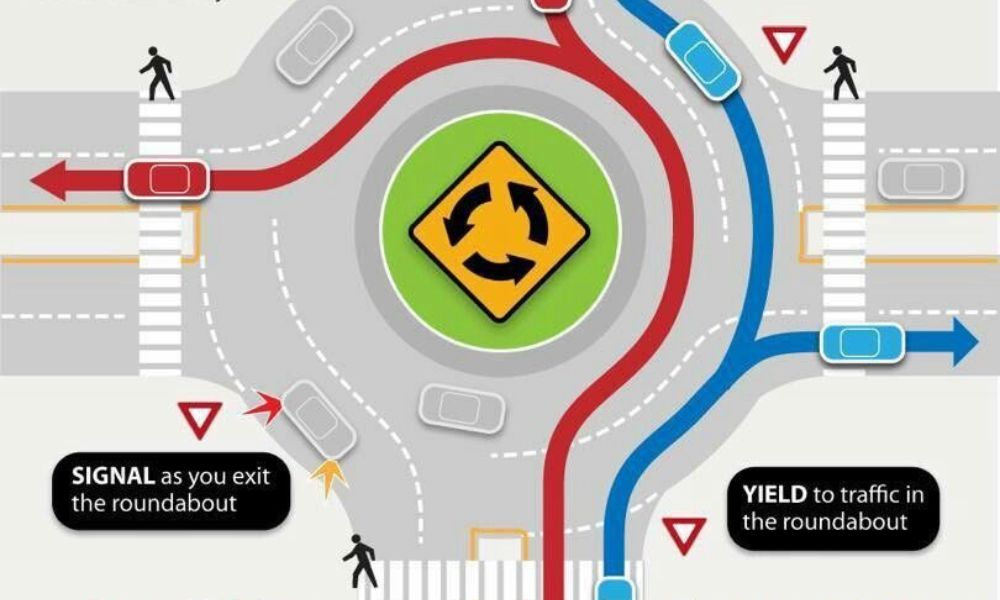
To use a roundabout in the UK, approach at a safe speed, check your mirrors, and choose the correct lane based on your exit. Give way to traffic coming from your right, wait for a safe gap, then enter. Keep to your lane, signal before your exit, and leave when clear.
What is a roundabout?
A roundabout is a circular junction that keeps traffic flowing without traffic lights at most sites. Vehicles travel clockwise around a central island, joining and leaving at various exits.
Roundabouts exist to reduce serious collisions. Because everyone moves in the same direction and slows down on approach, they cut out the high-speed, head-on crashes common at crossroads.
Key facts:
- Traffic flows clockwise in the UK.
- You give way to the right unless signs or road markings say otherwise.
- They keep traffic moving better than most signal-controlled junctions.
- Slower approach speeds mean fewer severe accidents.
How to use a roundabout UK: step-by-step
Follow these 12 steps every time you approach a roundabout. This routine mirrors the observation and control method the DVSA expects.
- Observe road signs early. Look for the roundabout sign and any road markings showing exits and lane choices. This tells you which lane you need.
- Check your mirrors. Use your centre and side mirrors to know what is behind and beside you before you slow down.
- Choose the correct lane. Pick your lane based on the exit you want, following the markings on the road.
- Reduce your speed. Ease off the accelerator and brake smoothly. In a manual, select a lower gear (often second) so you have good clutch control and can move off quickly.
- Give way to traffic from the right. Look right for approaching vehicles. Only enter when there is a safe gap.
- Watch for cyclists. Cyclists often stay in the left lane even when turning right, so give them room.
- Watch for motorcyclists. Motorbikes are small and easy to miss. Take a second look before pulling out.
- Watch for pedestrians. Check crossings on your approach and after your exit.
- Enter safely. When the gap is clear, move off confidently without hesitating.
- Maintain lane discipline. Stay in your chosen lane. Do not drift or cut across others.
- Signal before exiting. Indicate left just after you pass the exit before the one you want.
- Leave safely. Check your left mirror and blind spot, then exit smoothly. Cancel your signal once you are off.
Why the routine matters: Mirror checks and early observation give you time to react. Rushing or skipping mirrors is the most common cause of roundabout errors on test day.
Roundabout lane rules and positioning
Correct roundabout lane positioning depends on which exit you take. Always follow painted arrows and signs, as some junctions vary.
General rule:
- Turning left (first exit): Use the left lane. Signal left on approach.
- Straight ahead: Use the left lane unless markings say otherwise. No signal on approach, then signal left after the previous exit.
- Turning right or full circle: Use the right lane. Signal right on approach, then signal left before your exit.
Lane positioning comparison table
| Your direction | Approach lane | Approach signal | Exit signal |
| Left (1st exit) | Left | Left | Left |
| Straight ahead | Left | None | Left (after prior exit) |
| Right (last exit) | Right | Right | Left (before your exit) |
| Full circle | Right | Right | Left (before your exit) |
Spiral roundabouts change the game because lane markings guide you outward. We cover those below.
Mini roundabouts
A mini roundabout is a small junction marked by a painted or slightly raised central circle. Mini roundabout rules follow the same principle: give way to the right and travel clockwise.
What to remember:
- Give way to traffic from the right, just like a full roundabout.
- Signal your intentions clearly, as everything happens quickly.
- Do not drive straight over the central marking unless your vehicle is too large to go around it.
- Common mistake: treating it as “first come, first served.” Priority still goes to the right.
Because mini roundabouts are so compact, decisions come fast. Slow right down and make eye contact with other drivers where possible.
Multi-lane roundabouts
Large multi lane roundabout junctions carry heavy traffic and demand early planning.
How to handle them:
- Lane selection: Choose your lane well before you arrive, using signs and arrows.
- Positioning: Keep steady in your lane and follow the curve of the road.
- Changing lanes: Only move across when it is safe, after a mirror and blind-spot check. Avoid last-second lane changes.
- Exits: Signal left in good time and watch for vehicles in the lane beside you before leaving.
On a busy roundabout at rush hour, commit to your lane early. Weaving between lanes at the last moment is a leading cause of side-swipe collisions.
Spiral roundabouts
A spiral roundabout uses curved lane markings that guide you gradually toward your exit, so you should not need to change lanes once you are on it.
How to avoid mistakes:
- Follow the painted lines rather than driving in a fixed circle.
- Read the lane arrows on approach and trust the markings.
- Do not cut across the spiral, as this confuses other drivers and risks a collision.
Spiral layouts feel odd at first. The trick is to relax and let the lane carry you outward to your exit.
Traffic light-controlled roundabouts
Some roundabouts have traffic lights on the approaches or on the circle itself. When lights are showing, they override the normal give-way-to-the-right rule.
- Stop on red even if the roundabout looks clear.
- Move on green while still watching for other traffic.
- If lights fail, revert to the standard rule: give way to the right.
Roundabouts with cyclists
Cyclists are among the most vulnerable road users at roundabouts, so extra care is essential.
- Leave at least 1.5 metres of space when passing a cyclist.
- Check your blind spots, as cyclists can sit low and out of view.
- Expect cyclists to stay in the left lane even when going right around.
- Never squeeze past a cyclist as you exit. Wait behind them if space is tight.
Roundabouts with pedestrians
Pedestrians may cross at zebra crossings placed on the approach or exit roads.
- Give way to pedestrians waiting at a zebra crossing.
- Watch for people crossing just after you leave an exit.
- Never rush an exit if someone is about to step out.
Roundabouts in bad weather
Poor weather changes how you drive on a roundabout. Grip and visibility both drop, so give yourself more time.
- Rain: Brake earlier and leave bigger gaps. Wet roads double your stopping distance.
- Fog: Slow down and use dipped headlights. Open your window to listen for traffic if visibility is very low.
- Snow and ice: Accelerate and brake gently to avoid skids. Use a higher gear to reduce wheelspin.
- Reduced visibility at night: Rely on your headlights, and take extra time to spot cyclists and pedestrians.
Roundabouts during the driving test
DVSA examiners watch how safely and confidently you handle roundabouts. They are not looking for perfection, but for good judgement.
Examiners expect you to:
- Check mirrors before signalling and changing speed.
- Choose the correct lane and stay in it.
- Signal at the right time.
- Give way properly without stopping unnecessarily.
- Move off in a safe gap rather than hesitating too long.
Driving instructor advice: practise the mirror-signal-manoeuvre routine until it becomes automatic. Examiners reward smooth, decisive driving.
Common learner mistakes at roundabouts
Most faults come down to a handful of repeated errors. Watch for these:
- Wrong lane for the intended exit.
- Late signalling, confusing other drivers.
- Poor observation and missed mirror checks.
- Rushing into gaps that are too small.
- Hesitation, sitting still when it is safe to go.
- Cutting lanes across other vehicles.
- Incorrect speed, either too fast or crawling.
- Failing mirror checks before exiting.
Tips to build roundabout confidence
Confidence comes from repetition. These roundabout driving tips help nervous and learner drivers improve steadily.
- Start on quiet roundabouts at off-peak times.
- Practise with a qualified instructor who can guide your timing.
- Increase difficulty gradually, moving to busier and multi-lane junctions.
- Talk through your plan out loud to sharpen decision-making.
- Focus on smooth observation rather than speed.
Frequently asked questions
Do you always give way to the right?
Yes, unless signs, road markings, or traffic lights tell you otherwise. Giving way to the right is the core rule of giving way at roundabouts in the UK.
Can you change lanes on a roundabout?
Yes, but only after checking mirrors and blind spots. Change smoothly and never cut across another vehicle.
What happens if you miss your exit?
Stay calm and continue around the roundabout until you reach your exit again. Never stop or reverse.
How fast should you drive?
Approach slowly enough to stop if needed, usually in second gear. Match your speed to traffic and conditions.
Do you signal going straight ahead?
No signal on approach. Signal left after you pass the exit before yours.
What lane should I use?
Left lane for left turns and straight ahead, right lane for right turns and full circle, unless markings say otherwise.
Can cyclists use the middle lane?
Cyclists may use any lane but often stay left for safety. Give them plenty of room whatever lane they choose.
Are mini roundabouts different?
They follow the same give-way rule but happen faster. Slow down and signal clearly.
What happens during the driving test?
Examiners check your observation, lane choice, signalling, and timing. Smooth, safe driving passes.
Can you stop on a roundabout?
Only if traffic ahead forces you to, or a light is red. Never stop without reason.
Conclusion
Using a roundabout safely comes down to a simple routine: observe early, check your mirrors, choose the right lane, give way to the right, and signal before you exit. The same principles apply whether you face a mini roundabout, a busy multi-lane junction, or a spiral layout with traffic lights.
Follow the Highway Code roundabout guidance, take your time in bad weather, and always look out for cyclists and pedestrians. Most of all, practise regularly. With each roundabout you tackle, your timing and confidence grow, turning one of driving’s trickiest challenges into second nature.