There is no legal minimum number of driving lessons in Great Britain. Most learners need roughly 30 to 45 hours of professional driving lessons, often supported by extra private practice, before they reach test standard. But this is only a guide, not a rule. Some people take fewer hours, others take more. What really matters is whether you can drive safely and independently, not how many hours you have logged. This guide explains the typical driving lesson hours UK learners need, what affects your learning time, and how to know when you are genuinely ready for your practical driving test.
Quick Answer: How Many Driving Lesson Hours Do You Need?
You need enough hours to drive safely, confidently and without constant help from your instructor.
- No legal minimum exists for lessons or practice hours in Great Britain.
- Many learners take around 30–45 hours of professional tuition.
- Private supervised practice on top of lessons can be very valuable.
- Readiness beats hours. A learner who practises regularly may progress faster than someone counting hours alone.
Think of the 30–45 hour range as a starting expectation, not a target to tick off.
How Many Driving Lessons Does the Average UK Learner Need?
The often-quoted figure is that learners take roughly 40 hours of lessons plus additional private practice. This is a helpful benchmark, but it is not a promise or a requirement.
Every learner is different. Some feel comfortable after 25 hours. Others need 50 or more. Both outcomes are completely normal.
Your progress depends on how quickly you build key skills:
- Controlling the car smoothly
- Reading the road ahead
- Judging speed and gaps
- Handling junctions, roundabouts and manoeuvres
Key takeaway: Focus on steady, measurable improvement rather than reaching a specific hour count.
Is There a Legal Minimum Number of Driving Lessons in the UK?
No. According to GOV.UK, there is no legally required number of lessons or private practice hours before you take your test. You only need to:
- Be at least 17 (or 16 if you receive the enhanced rate mobility component of PIP)
- Hold a valid provisional driving licence
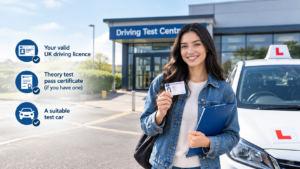
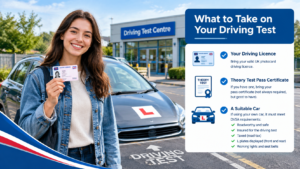
- Pass your theory test before booking your practical test
You are free to take as few or as many lessons as you like. The law sets the standard you must reach on test day, not the path you take to get there. Always check the latest requirements on GOV.UK, as rules can change.
The difference matters: A “typical range” describes what most people experience. A “legal requirement” is a rule you must follow. The 30–45 hour figure is the former, not the latter.
What Affects How Many Driving Lessons You Need?
No two learners follow the same path. Several factors shape how long it takes to reach test standard.
Confidence and Nerves
Anxious learners often need more time early on to feel settled behind the wheel. That is perfectly fine. Patient, supportive teaching usually helps confidence grow lesson by lesson.
Previous Driving Experience
If you have driven before, even off-road or abroad, you may pick up some skills faster. Complete beginners naturally start from scratch.
How Often You Take Lessons
Frequent, consistent lessons help skills stick. Long gaps between sessions often mean revisiting things you have already covered.
Amount of Private Practice
Supervised practice between lessons can speed up progress, as long as it is legal and safe.
Recognising Hazards
Good road awareness takes time. Spotting and responding to hazards early is central to safe driving.
Traffic and Road Complexity
Busy urban routes, like those across South West London, expose you to more junctions, roundabouts and pedestrians. This builds experience but can take longer to master.
Manoeuvres and Independent Driving
Parking, reversing and following directions without prompts are common areas where learners need extra practice.
Manual Versus Automatic
Manual cars add clutch control and gear changes to learn. Automatics remove those tasks, which some learners find simpler.
How Much Private Practice Should You Do?
Private practice is time spent driving with a family member or friend rather than a professional instructor. Used well, it reinforces what you learn in lessons.
There is no set number of hours, but many learners benefit from regular practice alongside professional tuition.
To practise legally, the supervising driver must:
- Be at least 21 years old
- Have held a full licence (for that type of car) for at least three years
- Meet all current learner-driver requirements on GOV.UK
Your car must also be properly insured for a learner, and L-plates must be displayed. Always check the latest rules before you start.
Important: Private practice supports lessons, it does not replace professional teaching. Your instructor helps you build correct habits from the start.
How Do You Know When You Are Ready for Your Driving Test?
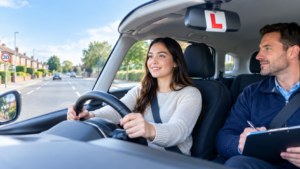
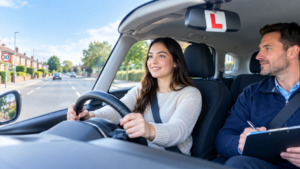
Readiness is about competence, not lesson count. You are likely ready when you can consistently:
- Drive safely without constant instructor intervention
- Handle common road situations calmly
- Make correct mirror and blind-spot observations
- Respond appropriately to hazards
- Maintain suitable speed and road position
- Deal with junctions and roundabouts safely
- Complete the required manoeuvres competently
- Follow directions and drive independently
- Make safe decisions again and again
A good instructor will be honest with you about your progress. Mock tests are one of the best ways to check whether you are ready for the real thing.
Do Automatic Learners Need Fewer Driving Lessons?
Automatic cars remove clutch control and gear changing, so there is less to think about. Many learners find this less stressful, especially nervous drivers.
This can make early lessons feel easier, but it does not guarantee fewer hours overall. You still need to master observation, road position, hazard awareness and manoeuvres.
Remember: passing in an automatic gives you an automatic-only licence. If you want to drive a manual later, you would need to pass a separate manual test. If you are unsure which suits you, automatic driving lessons are worth exploring during a first session.
Can Intensive Driving Courses Help You Learn Faster?
Intensive courses compress learning into days or weeks rather than months. They suit learners who want to focus fully and prepare quickly.
An intensive course changes the timeframe, not the standard. You still need to reach the same level of skill and safety, and no course can guarantee a pass.
Options like the Fast Pass intensive course or the Fast Track intensive course can work well if you learn best with concentrated, back-to-back practice. Flex Driving Academy also offers a longer Fast Forward option for complete beginners.
Rule of thumb: Intensive learning works best when you are ready to commit time and energy over a short period.
How to Make Your Driving Lessons More Effective
Want to avoid unnecessary lessons? These habits help you get more from every hour:
- Take lessons consistently to keep momentum
- Practise safely between lessons where you legally can
- Review your mistakes after each session
- Work on specific weaknesses rather than repeating what you already do well
- Ask for measurable progress targets from your instructor
- Practise varied conditions, including different roads, weather and times of day
- Do mock tests before booking the real one
- Avoid booking a test just because you have hit a certain number of hours
Common mistake: Booking a test based on hours rather than readiness. Book when your instructor agrees you are driving to test standard.
How Flex Driving Academy Can Help
Flex Driving Academy is a South West London driving school built around confident, safe learning. Whether you are a complete beginner or a nervous driver, lessons are paced around you.
You can expect:
- DVSA-approved instructors
- Manual and automatic lessons
- Flexible scheduling, including evenings and weekends
- Female instructors available on request
- Local test-route knowledge across the areas we cover, including Wallington, Wimbledon, Tooting, Morden, Sutton and Croydon
- Intensive options, including Fast Pass, Fast Track and Fast Forward
- Lessons inside and outside the M25
Because instructors teach on the same roads and roundabouts your test centre uses, test day feels familiar rather than foreign.
Frequently Asked Questions
How many hours of driving lessons do I need in the UK?
Most learners take around 30–45 hours of professional lessons, often with extra private practice. This is a typical range, not a rule. Your readiness matters more than the exact number.
Is there a minimum number of driving lessons in the UK?
No. GOV.UK confirms there is no legal minimum for lessons or practice hours. You must simply meet the required driving standard on test day.
Is 30 hours of driving lessons enough?
For some learners, yes. Others need more. Thirty hours can be enough if you can drive safely and independently, but it is not a guaranteed figure.
Is 40 hours of driving lessons enough to pass?
Forty hours is a common benchmark, and many learners are test-ready around this point. However, it does not guarantee a pass. Competence, not hours, decides readiness.
How long does it take to learn to drive?
It varies widely. Some pass within a few months of regular lessons, while others take longer. Frequency, practice and confidence all affect the timeline.
Do I need private practice as well as driving lessons?
It is not legally required, but supervised private practice can speed up progress. The supervising driver must meet GOV.UK requirements and the car must be correctly insured.
Can I pass my driving test with fewer lessons?
Possibly, if you learn quickly and practise regularly. There is no minimum, so what counts is reaching the required standard safely.
Are automatic driving lessons quicker?
Automatics remove clutch and gear tasks, which some learners find easier. This can help early on, but there is no guaranteed reduction in total hours.
How do I know when I am ready for my driving test?
You are ready when you can drive safely without constant help, handle hazards and junctions confidently, complete manoeuvres, and make consistent, safe decisions. Mock tests help confirm this.
Conclusion
There is no magic number of driving lesson hours. Many UK learners need roughly 30–45 hours of professional tuition, often with private practice, but this is only a guide. What truly matters is being able to drive safely, confidently and independently.
If you would like a realistic assessment of where you stand, get in touch with Flex Driving Academy. After your first couple of lessons, your instructor can give you a personalised estimate and a clear plan to help you reach test standard, at your own pace.